A Visual Guide to Gospel Events by James C. Martin
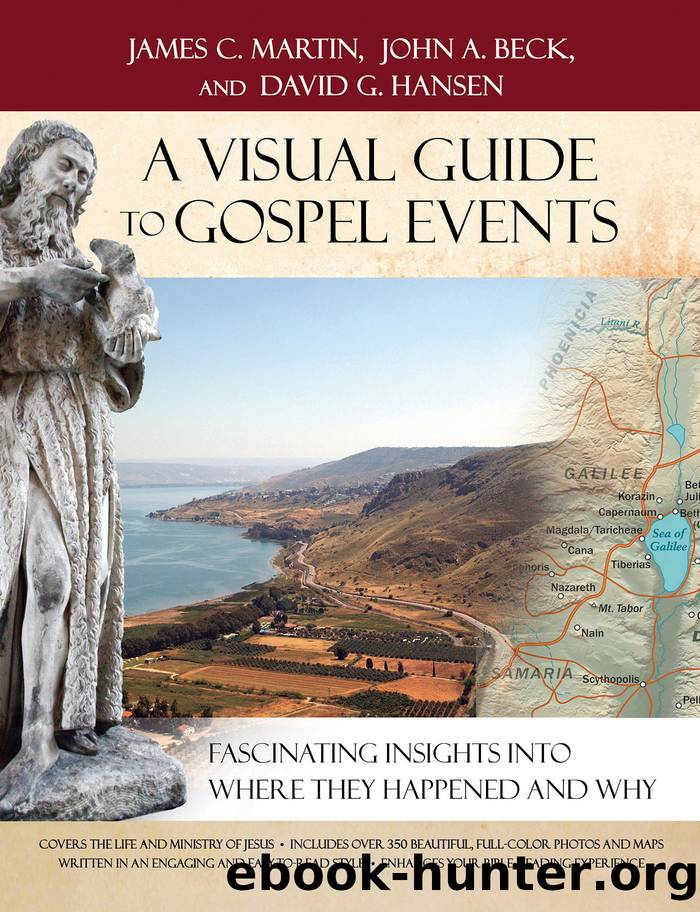
Author:James C. Martin [Martin, James C., John A. Beck and David G. Hansen]
Language: eng
Format: epub
Tags: REL006160, REL006000, Bible—Geography, Bible stories (English), Bible—Criticism (interpretation etc.)
ISBN: 9780801013119
Publisher: Baker Publishing Group
Published: 2015-08-23T16:00:00+00:00
Excavation of the Bethesda Pools in the foreground, with the Church of St. Anne’s in the background.
JESUS TRAVELS TO THE TEMPLE FOR THE FEAST OF TABERNACLES
JOHN 7:1–38
Jesus had been chided by those who wanted him to leave Galilee and travel to Jerusalem for the Feast of Tabernacles to perform miracles and show himself to the world (John 7:2–4). Jesus answered, “You go to the Feast. I am not yet going up to this Feast, because for me the right time has not yet come” (John 7:8). After his critics left for Jerusalem, however, the right time came for Jesus to make the journey in secret. Clearly there was something important drawing Jesus to the Temple at this time—an opportunity he did not want to miss.
The Feast of Tabernacles had two primary purposes. First, because the feast fell in autumn at the close of the summer harvest season, it was the occasion for the nation of Israel to give thanks, celebrating the close of another successful agricultural year. Moses had instructed the people, “For seven days celebrate the Feast to the LORD your God at the place the LORD will choose” (Deut. 16:15). Second, this feast taught and reminded the people of an important history lesson. It reviewed the time Israel had spent in the wilderness under God’s protecting hand as they traveled from Egypt to the Promised Land (Lev. 23:43).
There were three elements that helped accomplish the purposes of the festival. First, special offerings were made each day at the Temple in thanksgiving for the blessing of the harvest (Lev. 23:36). Second, temporary shelters (also called booths or tabernacles) were built by families because God had directed the Israelites to live in these shelters during this special week as a reminder of how their ancestors lived during their stay in the wilderness (Lev. 23:42–43). Third, everyone had in hand a citrus fruit and a lulab, which was a cluster of three branches (Lev. 23:40)—such as myrtle, willow, and palm—that recalled the stages of the wilderness journey.9
Download
This site does not store any files on its server. We only index and link to content provided by other sites. Please contact the content providers to delete copyright contents if any and email us, we'll remove relevant links or contents immediately.
The Lost Art of Listening by Michael P. Nichols(7506)
Why I Am Not A Calvinist by Dr. Peter S. Ruckman(4153)
The Rosicrucians by Christopher McIntosh(3521)
Wicca: a guide for the solitary practitioner by Scott Cunningham(3179)
Signature in the Cell: DNA and the Evidence for Intelligent Design by Stephen C. Meyer(3138)
Real Sex by Lauren F. Winner(3023)
The Holy Spirit by Billy Graham(2953)
To Light a Sacred Flame by Silver RavenWolf(2823)
The End of Faith by Sam Harris(2742)
The Gnostic Gospels by Pagels Elaine(2531)
Waking Up by Sam Harris(2461)
Nine Parts of Desire by Geraldine Brooks(2369)
Jesus by Paul Johnson(2362)
Devil, The by Almond Philip C(2332)
The God delusion by Richard Dawkins(2309)
Heavens on Earth by Michael Shermer(2284)
Kundalini by Gopi Krishna(2185)
Chosen by God by R. C. Sproul(2164)
The Nature of Consciousness by Rupert Spira(2108)
